コロラド対ジョージア工科大学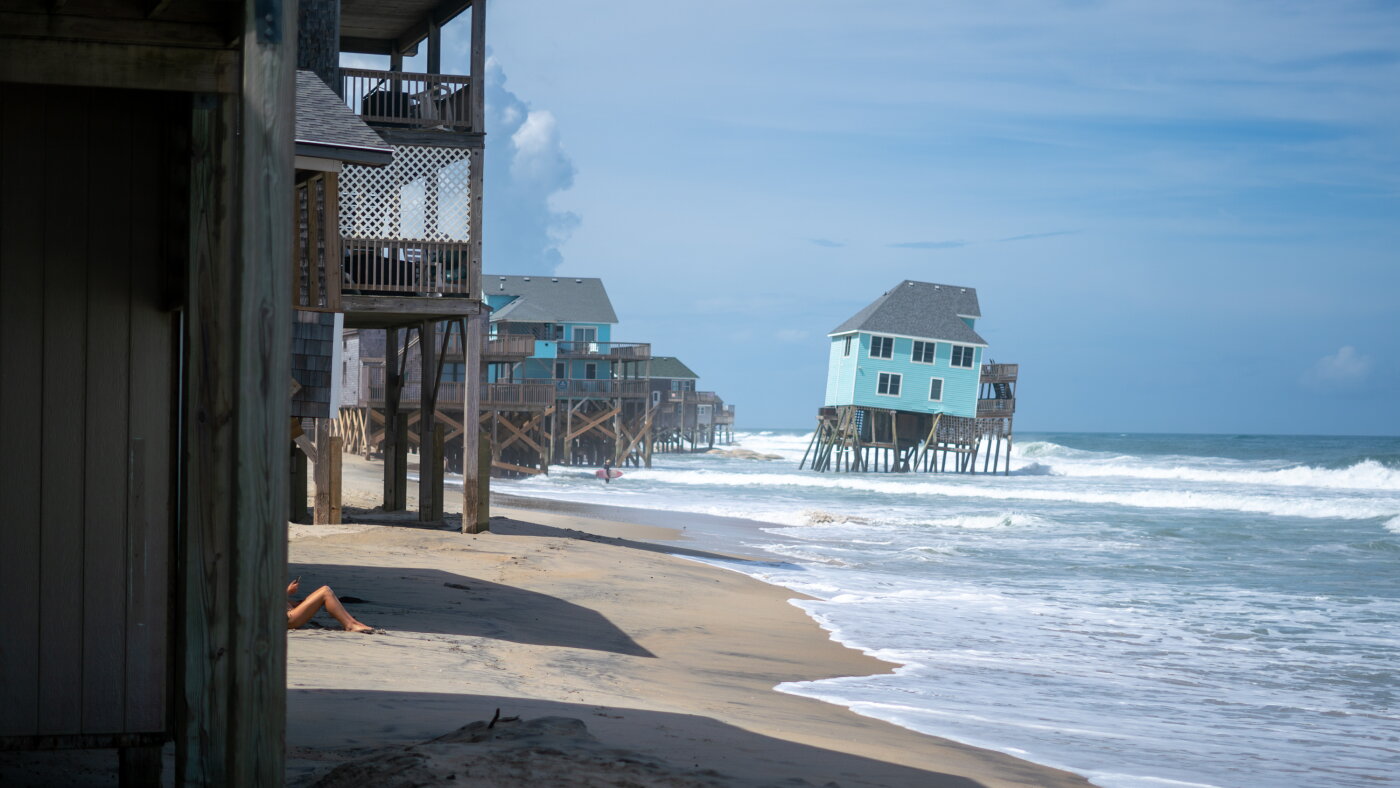
Richard Foreman’s home is stranded in the middle of the beach.
The stairs were ripped away by waves years ago, so there’s no way in or out anymore. The house is 20 feet into the air, on stilts that were designed to protect it from hurricane storm surge. But there haven’t been any big storms recently, just the rising ocean eating away at the sand year after year.
Just six years ago, the house was still a popular vacation rental in Rodanthe, North Carolina. Like many beachfront houses, it had a nickname: Sea ‘n Delight. Today, the name is gone, and the house is uninhabitable. At low tide, the Atlantic Ocean laps at what used to be the driveway. At high tide, the ocean runs beneath the entire house.


Waterfront houses are collapsing because of erosion. The erosion is exacerbated by sea level rise caused by climate change. More than 30 homes have collapsed in Dare County since 2020.
National Park Service
hide caption
toggle caption
National Park Service
Foreman knows it will collapse eventually. Four neighboring homes have fallen into the ocean in the last two years. And more than 100 homes on North Carolina’s barrier islands are at risk from erosion and sea level rise in the next decade, according to the National Park Service, which manages the area as part of Cape Hatteras National Seashore.
At least half a dozen of those houses are in imminent danger. In June, a high tide coupled with large waves was enough to bring down another house.
Yet there is no plan to remove most of the threatened houses or to empty them of personal belongings, because of perverse incentives created by the Federal Emergency Management Agency (FEMA).

Bill King, the president of the North Carolina Beach Buggy Association, has traveled to Washington, D.C., to push for federal rule changes that he thinks could save homes from collapsing in coastal North Carolina.
Ryan Kellman/NPR
hide caption
toggle caption
Ryan Kellman/NPR
FEMA provides most residential flood insurance in the United States. The agency will pay homeowners after a house collapses, but not before. That means owners stand to lose tens or even hundreds of thousands of dollars by tearing down a doomed house before the ocean takes it.
“The homeowner is incentivized to wait for collapse and get a payout,” says John Ryan-Henry, a policy analyst at the Coastal States Organization, a nonprofit that advocates on behalf of coastal state governments, including those along the Great Lakes.
And when homes collapse, they pollute the water and leave wreckage on the shore.
“Unfortunately, there’s a lot of debris that comes with these collapses,” says Lisa Sharrard, a longtime flood insurance agent in North Carolina who previously served as the chair of the Association of State Floodplain Managers, which is the trade group representing state flood-policy officials. “It leaves a legacy of hazard on the beach. It’s almost impossible to get everything.”
The National Park Service says it collected more than 480 tons of home debris from the area in the last 18 months alone, some of which washed miles down the North Carolina coast.

As sea level rise accelerates erosion around the U.S., there is growing alarm among waterfront homeowners, local officials and even members of Congress. Here, a damaged porch hangs precariously over the sand on the Cape Hatteras National Seashore.
Ryan Kellman/NPR
hide caption
toggle caption
Ryan Kellman/NPR
Foreman’s stranded house hasn’t been emptied out.
“It looked like we had just left for dinner. I mean, everything is still in there,” says Foreman. The couches, the refrigerator, every steak knife and beach towel — it’s all waiting to fall into the ocean.
“If they would settle with me for the insurance, I would have it torn down tomorrow,” he says.

As sea level rise from climate change accelerates erosion around the country, there is growing alarm among waterfront homeowners, local officials and even members of Congress. More than 30 homes have fallen into the sea in coastal North Carolina alone since 2020. Neighborhoods in Maine, Massachusetts, Michigan, Illinois, Virginia and California are facing similar threats. Just last week, erosion exacerbated by a storm caused catastrophic damage to multiple homes in Southern California.
“People should not have to wait for their home to collapse into the water before they can get help,” says Rep. Chellie Pingree, D-Maine. “That is just not a smart way to deal with the reality of climate change.”
FEMA says it cannot change the rules for threatened properties unless Congress amends the laws that govern the National Flood Insurance Program. Such a bill was introduced by a bipartisan group of lawmakers in 2025, but it is stalled in the House of Representatives.
FEMA did not respond to questions from NPR about the cost to taxpayers of letting homes collapse.

The Federal Emergency Management Agency provides most residential flood insurance in the United States. The agency will pay homeowners after a house collapses, but not before.
Ryan Kellman/NPR
hide caption
toggle caption
Ryan Kellman/NPR
Plenty of warning, but no good option
Erosion is an inescapable problem for waterfront communities. Waves remove sand and rock from some areas and deposit them in others.
Climate change is accelerating that natural erosion unevenly. Although global warming affects the entire planet, sea levels are rising more quickly in some regions because of ocean currents and the complex dynamics of melting glaciers and ice caps. Some of the fastest sea level rise in the world is occurring on the East Coast of the United States.

Coastal areas are constantly changing. Barrier islands, like the ones that form the Outer Banks of North Carolina, are particularly prone to erosion, as the ocean removes sand from some areas and deposits it in others. Even stable-seeming dunes can disappear as the ocean shapes the land.
Ryan Kellman/NPR
hide caption
toggle caption
Ryan Kellman/NPR
In North Carolina, where thousands of homes sit on narrow, sandy barrier islands, sea levels are rising faster than the global average, and the rate is accelerating.
Rising seas exacerbate the erosion that usually happens on barrier islands, says Reide Corbett, a climate scientist at East Carolina University. In the last six years, hundreds of feet of beach have disappeared in Dare County, N.C., the current epicenter of erosion-related home collapses in the United States.
“There is no way to maintain homes where they currently are,” Corbett says. He has delivered the same message directly to county residents at multiple public meetings in recent years. “The only solution is to back off that front line.”

Clarke Lattimore, 8, looks out the window of his family’s beach house in Buxton, N.C., in May. His great-grandfather built the house behind two rows of dunes. Now, it is threatened by the ocean.
Ryan Kellman/NPR
hide caption
toggle caption
Ryan Kellman/NPR

Susan Clarke (left) has been coming to Buxton since the 1970s. She says she was aware from the beginning that erosion would eventually threaten the beach houses there, although the speed of the destruction in recent years has been surprising. Her daughter, Bonnie Clarke Lattimore (pictured at right), was gutted when the family lost another beach home, affectionately called Dreamhouse 1, to the ocean in 2025.
Ryan Kellman/NPR
hide caption
toggle caption
Ryan Kellman/NPR
But removing homes from the front line is expensive. Tearing down a house costs at least $30,000, according to local contractors, and the price tag is even higher if the house is very large or difficult to access. The other option is to move homes farther away from the water, which can cost hundreds of thousands of dollars.
Most homeowners do not have that kind of money. Many of the at-risk properties in Dare County are vacation homes, and their owners rely on rental income to pay for the mortgage, taxes and insurance. As the ocean encroaches, many houses get damaged and become uninhabitable, saddling owners with high bills and no income at the very moment they need cash to prevent their homes from collapsing.

Michael McDaniel is in that situation with his house in Buxton, N.C., nicknamed the Sea Star. He purchased it for about $500,000 in 2011, when he retired from the Navy. He planned to eventually move there full time with his wife.
When he bought the house, about 250 feet of dune were between the front porch and the Atlantic. For years, the house seemed like a good investment. The property value rose and hit nearly $1 million just two years ago. But the beach eroded, and today the home is uninhabitable.
McDaniel says he can’t afford to move the house, which would be his first choice, or to demolish it. The house has a flood insurance policy that will pay out $250,000 if it collapses, plus up to $100,000 for lost belongings.
“If it’s teetering, you’ve got to sit and wait for it to fall in the ocean,” he says.
Foreman, whose house is stranded in the middle of the Rodanthe beach, is in a similar bind.

Extra sand has bought extra time for the owners of homes damaged by waves in recent years in Dare County, but the long-term problem of beach erosion persists.
Ryan Kellman/NPR
hide caption
toggle caption
Ryan Kellman/NPR
“Environmentally, it would be far better if they would allow me to tear it down on a beautiful day where all the debris is in one spot,” he says. “But by requiring the waiting game for it to fall, it’s going to fall in a storm, and it’s going to be scattered for miles.”
Taxpayers are on the hook for increasingly expensive cleanups. Federal and county governments together estimate that they have spent more than half a million dollars cleaning up debris in coastal North Carolina since 2020. Those figures do not account for the economic costs of closed beaches and polluted ecosystems.
County officials say they are frustrated by the federal government’s approach.
“If there are waves breaking under the house, that’s clearly threatened,” says Dare County Manager Robert Outten. “It’s money they’re going to spend either way. It’s cheaper to tear it down.”
Their frustration is even greater because they say the federal government created a solution to the problem nearly 40 years ago — and then killed it.

Homes in Buxton were originally built behind multiple rows of dunes. Today, those dunes are gone.
Ryan Kellman/NPR
hide caption
toggle caption
Ryan Kellman/NPR
The solution that Congress hated
In the mid-1980s, Congress stepped in to help homeowners with threatened homes.
The result was called the Upton-Jones Amendment to the National Flood Insurance Program. The law, named for lawmakers from the erosion hot spots of Michigan and North Carolina, allowed homeowners to access flood insurance payouts before a home fell, to pay for demolishing it or moving it.
The law took effect in 1988, and homeowners immediately started using it to get their houses out of harm’s way, according to partial claims records obtained from FEMA through a public records request and analyzed by NPR. More than 400 homes in 27 states were demolished or moved under the policy.

People fish off the pier in Avon, North Carolina.
Ryan Kellman/NPR
hide caption
toggle caption
Ryan Kellman/NPR
But Congress was not happy with the results.
The goal was to avoid having houses fall into the water. But in a series of congressional hearings, experts told lawmakers that some property owners were purposely waiting to remove their houses.
“They have chosen to repair the building as it stands, get another season’s rent and then look toward the possibility of demolition at a later date,” explained Spencer Rogers, who managed Upton-Jones claims for North Carolina, at a June 1990 congressional hearing. “There is no particular incentive that I can see for any early action.”
Lawmakers and FEMA officials expressed frustration that there was no penalty for such inaction. The longer the owner of a doomed home delayed, the more likely it was that the home would be damaged by waves or storms, leading to an expensive insurance claim. And if the house fell before the owner removed it, they could still collect their full flood insurance payout.

“People should not have to wait for their home to collapse into the water before they can get help,” says Rep. Chellie Pingree, D-Maine. Here, homes in Buxton stand over the waves in May.
Ryan Kellman/NPR
hide caption
toggle caption
Ryan Kellman/NPR
“Policyholder benefits come at the government’s expense,” said then-Rep. Doug Bereuter of Nebraska at another 1990 hearing about Upton-Jones.
Lawmakers were also concerned that the policy could bankrupt the National Flood Insurance Program if every eligible home took advantage of it. After years of debate about whether Upton-Jones could be fixed, Congress repealed it altogether in 1994.
Now, Congress is considering reinstating a version of the same policy.
Under pressure from homeowners and local governments, a bipartisan group of lawmakers last year proposed resurrecting a version of the Upton-Jones law.
“For some homeowners in vulnerable coastal areas, relocation or demolition may be the safest and most practical option,” says Rep. Chellie Pingree, D-Maine, one of the bill’s co-sponsors. She says the bill “is about giving people that option before disaster strikes, not after everything is already lost.”
The new bill attempts to address some of the problems identified in Upton-Jones back in the 1990s. If a homeowner fails to remove their threatened house before it collapses, they may not get their full insurance payout. And the process for determining whether a house is in imminent danger from erosion is simplified.
But the bill has not gotten enough support to move forward. The Trump administration’s efforts to slash FEMA’s workforce and budget have made it harder for popular bipartisan efforts to reform the agency to find traction in Congress.

Brian Harris runs the Buxton Civic Association in Buxton. In recent years, he has been pushing the state and federal governments to change rules that make it difficult to protect waterfront homes and to remove them before they collapse.
Ryan Kellman/NPR
hide caption
toggle caption
Ryan Kellman/NPR
FEMA never analyzed the full cost of Upton-Jones
Upton-Jones retains its reputation as a failed and expensive program three decades after it was repealed. But it’s unclear how accurate that reputation is, because FEMA never conducted a full analysis of its cost-effectiveness. “There was never a really robust postmortem,” says Ryan-Henry, of the Coastal States Organization.
FEMA’s complete data on flood insurance claims are private, making it impossible to know how Upton-Jones ultimately compares with other federal programs for removing threatened homes.

But narrower claims data obtained by NPR through a public records request offers a clue. Adjusted for inflation, the average cost to demolish a home was roughly the same as the cost of a federal home buyout, in which the government purchases repeatedly damaged homes in flood zones at market value and pays to demolish them.
In higher-cost areas, Upton-Jones could even be cheaper. The proposed program would cap payouts at $250,000, while the separate, existing buyout program pays full market value. More than 90% of the homes that have fallen in Dare County since 2020 were assessed above $250,000.
Without long-term solutions available, many local and state governments are relying on expensive alternatives such as beach nourishment and seawalls.

Removing homes before they collapse costs tens of thousands of dollars. A bill pending in Congress would let homeowners access money through their flood insurance policies to help foot that bill.
Ryan Kellman/NPR
hide caption
toggle caption
Ryan Kellman/NPR
In Maine, a project is underway to build a jetty to slow erosion near houses in the threatened community of Camp Ellis in the town of Saco. And Dare County, N.C., has two multimillion-dollar projects underway: an $8.6 million jetty repair and a roughly $15 million beach nourishment project that will pump more than 2 million cubic yards of sand in front of the most threatened houses. The sand from the last beach nourishment in the area lasted less than three years.
“Beach nourishment is temporary,” says Corbett, the climate scientist at East Carolina University. “You’re buying sand to buy time. You can’t simply buy time and not plan for what is next.”
And not every neighborhood is getting sand or other protections. At this rate, Richard Foreman doesn’t see a path to either protecting or removing his stranded house in North Carolina. “Which leads you to believe they’re really just hoping [the homes] will fall instead,” Foreman says. “It’s nuts. It’s absolutely nuts.”
Additional editing by Neela Banerjee. Molly Enking of Maine Public, along with Sarah Knight and Katie Daugert of NPR, contributed reporting.