コロラド対ジョージア工科大学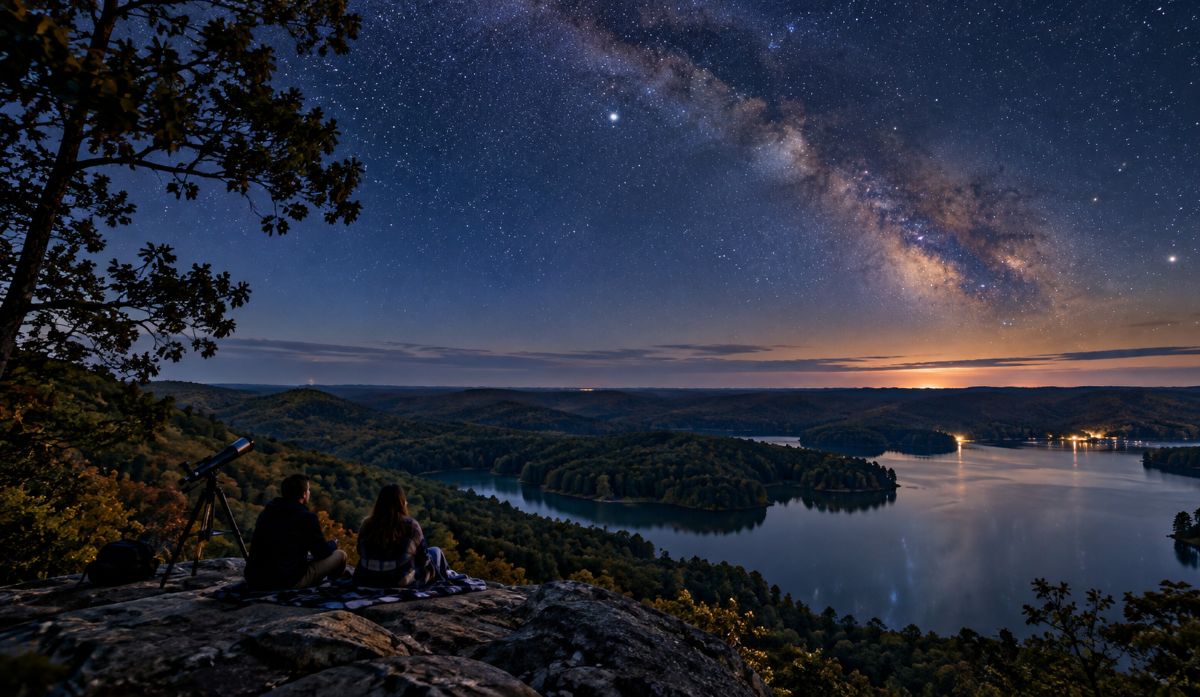
September 6, 2026 6:49 PM
Image generated with Ai
Have you ever looked up to an orange, hazy mess? That’s how a lot of us are used to seeing the night sky. It’s understandable why people think that “haze of light” is all that stands between them and the universe. It’s an enormous space that we have grown to ignore, and take for granted our dull, urban surroundings without realizing it. That awe and that wonder are still there; we have just become disillusioned. Places like the Hocking Hills are combating something called sky glow to let people see the beauty like they once did. Ohio is combating sky glow with the help of scientists, dreamers, and lovers of the wild unknown and is starting to preserve urban wilderness to protect our night skies. Looking out onto Stonelick Lake and the Hocking Hills, you can lose yourself and reconnect with the universe amongst the twinkling stars. These places are reserved as dark sky sanctuaries to help people remember their place.
Why Is Cleveland’s Montville Hub At Observatory Park Considered A Premier International Dark Sky Park Destination?
Located roughly 40 miles east of downtown Cleveland, Observatory Park in Montville Township operates under the management of the Geauga Park District. Certified as a Silver-Tier International Dark Sky Park, this 1,100-acre reserve preserves genuine darkness using fully shielded, downward-facing outdoor lighting fixtures. Visitors gather at Oberle Observatory to look through its restored 25-inch Warner & Swasey reflector telescope or enjoy educational shows inside the planetarium. Situated at 41.6° N latitude, the park gives astrophotographers clear rural horizons to record the Aurora Borealis during geomagnetic storms.
How Does Cuyahoga Valley National Park Preserve Dark Skies Near Dense Metropolitan Corridors Between Akron And Cleveland?
Advertisement
Advertisement
Cuyahoga Valley National Park protects a winding river landscape nestled directly between the urban centers of Akron and Cleveland. Natural valley topography screens out low-horizon light glow from suburban developments, preserving surprisingly clear night skies for late-evening visitors along the trails. Park rangers preserve night conditions by replacing outdated fixtures with low-impact lighting that directs illumination strictly downward onto walking paths. Viewpoints like Ira Trailhead, Beaver Marsh, and Oak Hill Day Use Area offer unobstructed vantage points for watching annual meteor events like the Perseids and Geminids.
What Makes Canton’s Magnolia Hub At Fry Family Park An Outstanding Certified Urban Night Sky Place Model?
Situated south of Canton in Magnolia, Fry Family Park spans over 330 acres managed by the Stark County Park District. DarkSky International designated the location as an Urban Night Sky Place to highlight its successful lighting initiatives near growing suburban communities. The facility demonstrates ideal outdoor illumination by using 100 percent fully shielded fixtures rated at warm color temperatures under 2700 K. Open observation fields allow regional photographers to capture long-exposure deep-sky images without traveling far from major city centers.
Why Is Logan’s Hocking Hills Region Home To The Exceptional John Glenn Astronomy Park Stargazing Facility?
Advertisement
Advertisement
Set within the unglaciated Allegheny Plateau near Logan, the Hocking Hills region offers some of the darkest night skies in the Midwest. The John Glenn Astronomy Park was custom-built here to take full advantage of this protected low-light environment. The facility includes an 80-foot open plaza, a roll-off roof observatory with a 28-inch telescope, and hydrogen-alpha solar instruments. Clear southern horizons allow astrophotographers to shoot detailed images of the galactic core throughout spring, summer, and autumn.
How Does Cincinnati’s Bethel Hub At Stonelick State Park Offer Deep Celestial Views For Astronomy Enthusiasts?
Located 25 miles east of Cincinnati near Bethel, Stonelick State Park centers around a 200-acre lake enclosed by more than 1,000 acres of protected woodland. Managed alongside the Cincinnati Astronomical Society, the park provides a dark retreat for regional stargazers. The wide open beach faces east and south over dark water, reducing thermal air currents and blocking suburban ground lights. Local astronomy groups set up telescopes along the shore to observe planetary transits, distant star clusters, and seasonal constellations.
What Sustainable Tourism And Local Economic Impacts Stem From The Growing Astro-Travel Movement In Protected Areas?
Dark-sky tourism drives year-round economic benefits by drawing travelers to rural towns during off-peak evening hours. Night visitors book local cabins, hire astronomy guides, and eat at nearby restaurants, boosting regional commerce outside normal peak seasonal hours. Sustainable astro-travel encourages local governments to adopt smart outdoor lighting codes that lower energy consumption and protect nocturnal wildlife. Preserving dark skies helps rural regions build sustainable travel destinations that protect habitats while strengthening community economies.
How Does Light Pollution Impact Astrophotography And Celestial Stargazing Across Ohio Regional Landscapes?
Excessive artificial outdoor lighting creates a dense skyglow that washes out faint nebulae, star clusters, and distant galaxies across populated metropolitan corridors. Atmospheric particles scatter upward-directed light back toward the ground, reducing contrast and diminishing natural human vision during late-night viewing sessions. Moving to protected state or local parks removes unwanted background light, enabling camera sensors to reveal clear structural details in deep-space targets using standard exposure settings. These darker natural conditions make it much easier for stargazers to capture vibrant galactic formations without heavy light glare.
Light pollution near metropolitan corridors makes viewing deep space challenging. Protected reserves, state parks, and astronomy hubs provide dark habitats that keep natural nightscapes intact. Visiting sites like Observatory Park, Cuyahoga Valley National Park, Fry Family Park, John Glenn Astronomy Park, and Stonelick State Park allows travelers to witness meteor showers and distant galaxies. These regional hubs safeguard dark skies while providing rewarding experiences for observers.
| City / Hub Region | Dark Sky Site Name | Governing Entity | Certification / Status | Bortle Class | Primary Celestial Focus |
| Cleveland (Montville) | Observatory Park | Geauga Park District | Certified Dark Sky Park (Silver) | Class 3–4 | Deep-sky imaging, Auroral tracking, Planetary observation |
| Akron (Peninsula) | Cuyahoga Valley NP | National Park Service | NPS Lightscape Program Site | Class 4–5 | Meteor showers, Seasonal constellation tracking |
| Canton (Magnolia) | Fry Family Park | Stark County Park District | Certified Urban Night Sky Place | Class 4 | Dark-sky lighting education, Suburban stargazing |
| Logan (Hocking Hills) | John Glenn Astronomy Park | ODNR / Friends of Hocking Hills | State-Dedicated Astronomy Park | Class 3 | Galactic Center capture, Solar imaging, Deep-space optics |
| Cincinnati (Bethel) | Stonelick State Park | ODNR / Cincinnati Astronomical Soc. | State Park Stargazing Site | Class 4 | Planetary transit tracking, Astrophotography |
Light pollution near metropolitan corridors makes viewing deep space challenging. Protected reserves, state parks, and astronomy hubs provide dark habitats that keep natural nightscapes intact. Visiting sites like Observatory Park, Cuyahoga Valley National Park, Fry Family Park, John Glenn Astronomy Park, and Stonelick State Park allows travelers to witness meteor showers and distant galaxies. These regional hubs safeguard dark skies while providing rewarding experiences for observers.
Photometric Calibration Metrics: Measuring Sky Brightness and Optical Clarity Across Ohio’s Dark Sky Sanctuaries
Evaluating night sky quality requires precise scientific measurement tools that quantify background skyglow and atmospheric transparency across regional landscapes. Dark sky reserves across Ohio rely on Sky Quality Meter readings to establish objective baselines of natural darkness. In protected rural sanctuaries like John Glenn Astronomy Park, luminance measurements register between 21.7 and 21.9 mag/arcsec², indicating exceptionally dark conditions with minimal light intrusion. Conversely, urban centers such as downtown Cleveland and Cincinnati measure between 16.0 and 18.0 mag/arcsec², where intense artificial lighting washes out faint celestial phenomena.
The Bortle Dark-Sky Scale further categorises these observational conditions based on visual targets. Metropolitan centers fall under Class 8 and 9, where skyglow restricts naked-eye visibility to a visual magnitude of roughly 4.0 or less. As observers move toward Class 3 rural skies, the naked-eye limit expands to magnitude 6.6 through 7.0, revealing intricate structural details within the Milky Way. Calculating the artificial sky brightness ratio allows conservationists to track how urban light pollution expands outward, ensuring that peripheral buffers around public parks remain protected against encroaching development.
Economic Yield and Extended Stays: How Overnight Astro-Travel Drives Ohio’s Outdoor Recreation Revenue
Astro-tourism provides a high-value economic driver for rural counties by transforming traditional daytime park visitation into overnight stays. Standard day-trippers typically spend money only on quick meals or fuel before returning home. In contrast, overnight stargazers invest significantly in local cabin rentals, specialized lodging, and regional dining options during their late-night observation trips.
To mitigate unpredictable weather and cloud cover, celestial travelers extend their average length of stay from 1.2 days to 2.8 nights. This extended footprint generates consistent seasonal revenue for rural communities during the autumn and winter shoulder seasons. By capturing night-sky tourism, Ohio expands its multi-billion-dollar outdoor recreation economy, providing sustainable revenue streams for family-owned businesses near state parks and dark-sky preserves.
Spectral Wavelength Engineering: Assessing the Shift to Low-Kelvin Full-Cutoff LED Infrastructure
Mitigating light pollution requires updating public outdoor lighting through careful spectral management and physical fixture design. Standard municipal LED installations often rely on high-temperature white bulbs rated between 4000 and 5000 Kelvin. These fixtures emit substantial blue-spectrum light at the
Image generated with Ai
wavelength, which scatters easily across the atmosphere and amplifies skyglow.
To counteract this, dark sky initiatives mandate outdoor lighting capped at 2700 Kelvin or lower. These warm amber LEDs reduce blue-light scattering while preserving night-vision adaptation for nearby observers.
In addition to color temperature controls, park authorities enforce strict Backlight, Uplight, and Glare (BUG) standards. Installing full-cutoff fixtures angled at
Image generated with Ai
tilt ensures an U0 uplight rating, eliminating direct upward light spill into the atmosphere. Municipalities that adopt these energy-efficient retrofits achieve 30% to 60% reductions in power usage, demonstrating that dark-sky conservation also delivers substantial economic savings.
Eco-Astronomical Impacts: How Artificial Light at Night Disrupts Ohio’s Wildlife and Migratory Pathways
Artificial light at night disrupts local ecosystems, disorienting wildlife across forest preserves and waterways. Over 350 species of migratory birds navigate through Ohio along the Mississippi and Atlantic Flyways during spring and autumn. Illuminated tall structures and urban skyglow disorient these birds during night flights, leading to fatal building collisions and altered migration routes.
Nocturnal insect populations suffer severe declines under artificial lighting. Continuous exposure disrupts nocturnal pollinators and interferes with mating signals in native species like fireflies (Lampyridae). Furthermore, high-intensity artificial glare suppresses melatonin production and disrupts natural circadian rhythms in wildlife, destabilizing food webs and ecosystem health across state park boundaries.
Solar Maximum Dynamics and Geomagnetic Aurora Tracking Across Northern Ohio Latitudes
Observing the Aurora Borealis from mid-latitude regions like Ohio depends directly on peak solar activity during 11-year solar cycles. Solar maximum conditions increase Coronal Mass Ejections (CMEs), sending charged particles toward Earth’s magnetosphere. Because northern Ohio sits at
Image generated with Ai
latitude, visible auroral displays require strong geomagnetic storm conditions, typically registering at a
Image generated with Ai
or
Image generated with Ai
rating.
Astrophotographers track real-time space weather metrics to position themselves before geomagnetic storms peak. Capturing faint auroral pillars requires fast camera lenses with wide apertures between
Image generated with Ai
and
Image generated with Ai
alongside elevated sensor sensitivities from ISO 3200 to 6400. These camera settings allow sensors to register vibrant red and green emissions that may remain subtle or sub-visual to the naked eye.
Optical Equipment Architecture: High-Aperture Telescopes and Imaging Systems in Public Observatories
Public observatories across Ohio rely on large-aperture optical systems to gather faint light from deep-space targets. The Oberle Observatory near Cleveland houses a historic 25-inch Warner & Swasey reflector, while John Glenn Astronomy Park features a custom 28-inch primary telescope. These large primary mirrors collect over 10,000 times more light than the human eye, resolving subtle structural details in faint nebulae, star clusters, and distant galaxies.
For daytime visitors, public facilities utilize specialized Hydrogen-Alpha (
Image generated with Ai
) solar telescopes centered at a narrow
Image generated with Ai
wavelength. These hydrogen filters block intense solar surface glare, allowing safe observation of dynamic chromospheric activity, solar flares, and prominences rising along the Sun’s edge.
Astrophotography Technical Benchmarks: Camera Sensor Exposures, Signal-to-Noise Ratios, and Focal Lengths
Capturing detailed deep-sky images requires careful calculation of shutter speeds to prevent star trailing caused by Earth’s rotation. Photographers apply mathematical guidelines like the 500 Rule or NPF Rule to determine maximum exposure times before point-source stars begin to streak.
Under dark Bortle 3 skies, low background illumination yields superior Signal-to-Noise Ratios (SNR). Photographers can stack 3x to 5x longer exposure sequences before background skyglow overwhelms faint nebular light. Operating camera sensors at ISO 1600 through 3200 preserves dynamic range, capturing fine dust lanes and rich colors within the Milky Way core without introducing excessive thermal sensor noise.
Lunar Phase Optimization and Seasonal Astronomy Windows: Planning High-Contrast Deep-Sky Expeditions
Successful astro-tourism expeditions depend on coordinating travel schedules with lunar phases and seasonal sky rotations. Planning trips during New Moon phases (0% illumination) or thin crescent moons ensures that moonlight does not illuminate the upper atmosphere. Eliminating lunar glare allows observers to detect subtle deep-space objects that are otherwise obscured during brighter moon phases.
Seasonal sky movements also dictate when key targets are visible throughout the year. The galactic core of the Milky Way rises above the southern horizon from late March through October, offering prime viewing conditions between 10:00 PM and 3:00 AM. Conversely, cold winter atmospheric windows from December through February feature low humidity and crisp atmospheric transparency, creating ideal conditions for observing high-altitude targets like the Orion Nebula and the Andromeda Galaxy.
The Final Verdict
In Ohio, you can experience silent starlight out in the dark-sky reserved area. Living in hyper-connected landscapes lit with electric lights all too often leaves people hurried and never looking up to see the stars and even feel small in the best way possible! The preservation of dark-sky zones restores humanity’s awe and wonderment of the universe. Stonelick Lake, from the John Glenn Astronomy Park, gives you a sense of calm and leads you to feel at peace. Gaze out over the open field and stars to find serenity. Stunning stillness means the stars have witnessed everything that has unfolded on this planet throughout time. We put a lot of value on our dreams among the stars and protecting the stargazing wonders.
Frequently Asked Questions
- What is the best time of year to view the Milky Way in Ohio?
The core of the Milky Way is most visible from late March through October, when Sagittarius rises above the southern horizon on moonless nights.
- Do I need expensive equipment to enjoy astro-tourism parks?
No. While astrophotographers bring camera rigs, visitors can see star clusters, bright planets, and the Milky Way using binoculars or the naked eye.
- How do dark-sky parks prevent light pollution from their own facilities?
Parks use fully shielded, downward-facing fixtures, low-wattage warm LEDs, and motion sensors to maintain safety without spilling light skyward.
Advertisement
Advertisement